Sunday, February 22, 2009

An Illustrated History of Computers

_________________________________________________
John Kopplin © 2002


The first computers were people! That is, electronic computers (and the earlier mechanical computers) were given this name because they performed the work that had previously been assigned to people. "Computer" was originally a job title: it was used to describe those human beings (predominantly women) whose job it was to perform the repetitive calculations required to compute such things as navigational tables, tide charts, and planetary positions for astronomical almanacs. Imagine you had a job where hour after hour, day after day, you were to do nothing but compute multiplications. Boredom would quickly set in, leading to carelessness, leading to mistakes. And even on your best days you wouldn't be producing answers very fast. Therefore, inventors have been searching for hundreds of years for a way to mechanize (that is, find a mechanism that can perform) this task.


This picture shows what were known as "counting tables" [photo courtesy IBM]
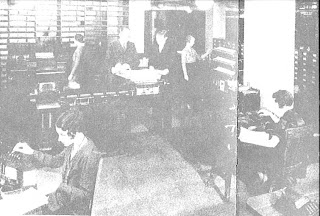
A typical computer operation back when computers were people.

The abacus was an early aid for mathematical computations. Its only value is that it aids the memory of the human performing the calculation. A skilled abacus operator can work on addition and subtraction problems at the speed of a person equipped with a hand calculator (multiplication and division are slower). The abacus is often wrongly attributed to China. In fact, the oldest surviving abacus was used in 300 B.C. by the Babylonians. The abacus is still in use today, principally in the far east. A modern abacus consists of rings that slide over rods, but the older one pictured below dates from the time when pebbles were used for counting (the word "calculus" comes from the Latin word for pebble).
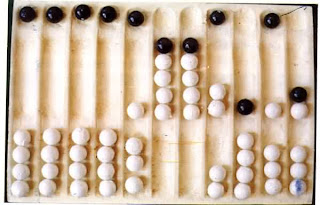

A very old abacus
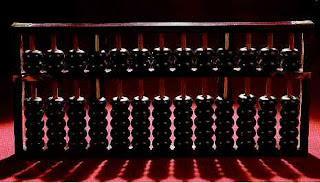

A more modern abacus. Note how the abacus is really just a representation of the human fingers: the 5 lower rings on each rod represent the 5 fingers and the 2 upper rings represent the 2 hands.

Saturday, February 21, 2009

Timeline of Computer History

YEAR

'39 '40 '41 '42 '43 '44 '45 '46 '47 '48

'49 '50 '51 '52 '53 '54 '55 '56 '57 '58

'59 '60 '61 '62 '63 '64 '65 '66 '67 '68

'69 '70 '71 '72 '73 '74 '75 '76 '77 '78

'79 '80 '81 '82 '83 '84 '85 '86 '87 '88

'89 90 91 92 93 94

WHAT THE TIMELINE IS
This timeline explores the history of computing from 1939 to 1994. Each year features illustrated descriptions of significant innovations in hardware and software technology, as well as milestones in areas such as commercial applications and artificial intelligence. When appropriate, biographical sketches of the pioneers responsible for the advances are included.
HOW THE TIMELINE WORKS
Across the top of this and every timeline is a graphic with the years from 1939 to 1994 displayed as well as seven topical areas. Clicking on any of these will take you to a page of historic information containing photos and descriptive text for that year or topic.
The timeline can either be browsed using the links above (and appropriate Previous/Next and More links on each page) or
searched for specific events.

Compaq Presario SG2000


Featuring genuine Windows Vista Home Basic with superior
digital entertainment and advance features. It is also having
robust technology choices at affordable prices so as you get
good value for your money. This desktop PC offers cutting-
edge processors, high-capacity hard drives and advanced
graph...
[Read More]
Write Review See Specifications Discuss
Available at
6 stores
from
Rs. 17,490

Compare Prices

New Products


N9600GT Hybrid Freezer
• NVIDIA® GeForce® 9600GT
• Hybrid freezer
• 1GB GDDR3 Memory

New Products


Altec Speakers
For generations, Altec Lansing has
been first in audio innovation.Today,
our line of poweredspeakers has
received

New Products


MSI U90Intel® Atom™ N270 1.6GHz
Processor with Intel®
945GSE+ICH7M chipset, 1GB
Memory, 8.9" 1024x600 LCD Panel